Production Management
Production Management is an arts-based bachelor’s programme within the field of performing arts production, designed to train you for the role as production manager.
A production manager holds overall responsibility for planning and organizing a theatre production. In this role, you work with budgets, schedules, contracts, logistics, and coordination between creative and technical departments. You ensure the successful integration of artistic visions and practical constraints, contributing to the efficient, professional, and safe execution of productions.
The programme teaches you how to plan and manage the production process from start to finish. You will acquire skills in budgeting, resource planning, collaboration, and communication. Additionally, you will gain a fundamental technical understanding and general knowledge of materials, enabling you to communicate and coordinate effectively with the various professional disciplines involved in a production.
You should be comfortable with responsibility and eager to engage in complex planning that balances finances, time, resources, and artistic visions. You should be curious about interdisciplinary collaboration within artistic development processes—and your own role within them—as well as interested in various forms of communication.
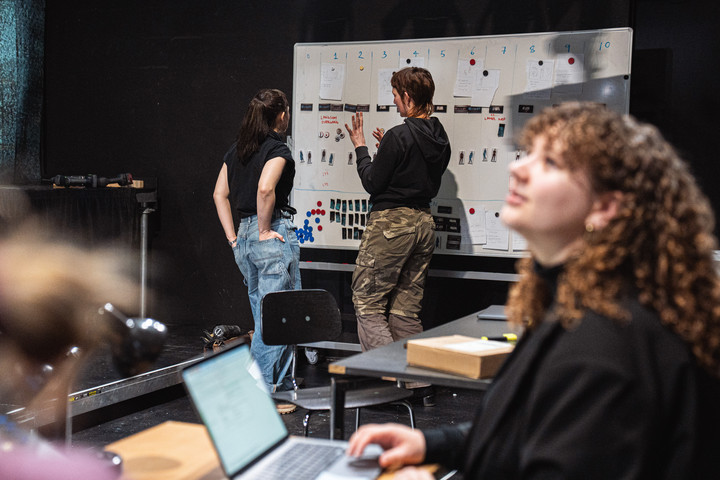
Instruction alternates between practice-based teaching, theoretical methodology, and project work. You will acquire new practical skills while learning to reflect on your own practice and use analytical methods as a foundation for your work. Throughout the programme, your professional skills and knowledge are put into practice through collaborations with students from other disciplines—ranging from exercises and smaller projects to major productions. The production management programme falls under the field of performing arts production, which also offers training for stage managers, technical stage managers, and prop makers. Together with the production manager, these four roles are close collaborators within the professional performing arts industry, sharing overlapping skills and competencies. Consequently, the four programmes share many common elements—reflected in significant cross-disciplinary teaching and a close-knit student community—while still offering ample opportunity to delve deeply into one’s own specific discipline.
Read more about the field of study here.






Employment
Graduates from the production management programme are typically employed to handle tasks within project and production/stage management. Most graduates continue to work in theatres or related areas within the cultural sector. As a production manager, you may hold a permanent position at a theatre, but freelance work and employment for specific productions or projects are also common.
Admission
Students are admitted once a year. Note that the application deadline typically falls already in December of the year before the programme begins. All students are admitted based on an entrance exam, where a selection committee evaluates applicants according to a number of criteria.
Read more in the application guide.


